HERALDIC INSTITUTE
10.11.24
Launch of Otto Hupp-style Calendar
Fellows Artwork to grace revival of Calendar

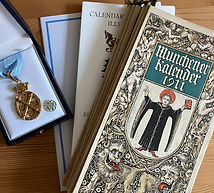
This Calendar follows the tradition of Otto Hupp’s Munich Calendar, with new artwork from our Fellows.
Numbered Limited Edition of 250. Sold on first come first served basis. No reservations.
Format 32cm (approx. 12.5inches) x 16cm (approx. 6inches). Fine Munken paper (one of the world’s most environmentally-friendly paper mills). Printed & bound in Germany (entirely powered by renewable resources).
12 months of the year with saints days (Catholic, Anglican and Orthodox), major festivals of other world religions and UN days of commemoration. Includes the saints days of some major chivalric and dynastic orders.
Illustrated with works by
Prisca van Dessel (Belgium)
Marco Foppoli (Italy)
Björn Frieden (Sweden)
Wilhelm Horwood (England/Germany)
Carlos Navarro (Spain)
Mathilde Årnfelt Ramström (Sweden)
George Shinas (Greece)
and including short articles by
Ralf Hartemink (Netherlands)
John Müller (Germany/England)
At the end of the 19th century paper wall calendars were very popular in the German-speaking world. In 1884 the Zentralverein für Kirchenbau (central church-building association) decided to join the fashion by issuing an art calendar as a fundraiser. For this they approached the artist Otto Hupp. The first of these Münchener Kalender was issued in 1885. These calendars show, besides the different months and some general information on the year, the arms of the zodiac signs, as well as a version of the arms of Munich on the front page. In 1895 Hupp finally got permission to add twelve arms of German States or important noble families in each calendar. From then on at the end of the calendar genealogical data on the different families were added, written by Gustav A. Seyler and from 1922 onwards by Dr von Klocke. Some also included large foldable plates with either the Bavarian Royal arms or the arms of breweries in the city of München.
In the early 1900s Hupp issued the calendars by himself without the association.Eventually, he published 51 issues in the years 1885 to 1936. In the mid 1930s this type of calendars slowly went out of fashion. Sales slumped and in 1933 no calendar was issued. He tried again in 1934 and 1935, but sales were poor. In 1936 he designed a new type of calendar. All previous calendars had the same format, similar to the many other calendars at the time, bound volumes with two pages per month, one with the actual calendar, the other with some engraving. This 1936 version was no longer bound with two pages per month, but had a page per week, which could be torn off. Due to the small number of calendars printed and the fact that the pages were torn, a complete 1936 calendar is very rare nowadays. The calendar was not a success and Hupp never issued a 1937 version.